The AI Media Death Spiral
Nobody reads the news anymore, we say. The data says the feed still runs on it, and the people who make it are disappearing.
Nobody reads media anymore. We get our information from social feeds and influencers.
Half of that is true. Social and video networks are now the biggest source of news across 48 markets: 54% of people use them for news every week, ahead of news websites and apps at 51%. More than a quarter, 27%, get news from creators and personalities. In the US, one in five adults regularly gets news from news influencers, and 77% of those influencers have never worked at a news organisation.
Now follow the links back. In a UNESCO survey of content creators, mainstream news media was one of their main sources for 36.9%. When AI assistants answer a question, journalism is the single largest type of source they cite, 27% of all citations, led by Reuters, Axios, the Financial Times and AP. Even before AI, a Pew study of Baltimore's news found that when a story contained new information, 95% of the time it came from traditional media. Influencers and chatbots don't replace reporting. They repackage it.
The feed still runs on newsrooms. The newsrooms are the part that is disappearing.
1. Search stopped sending readers
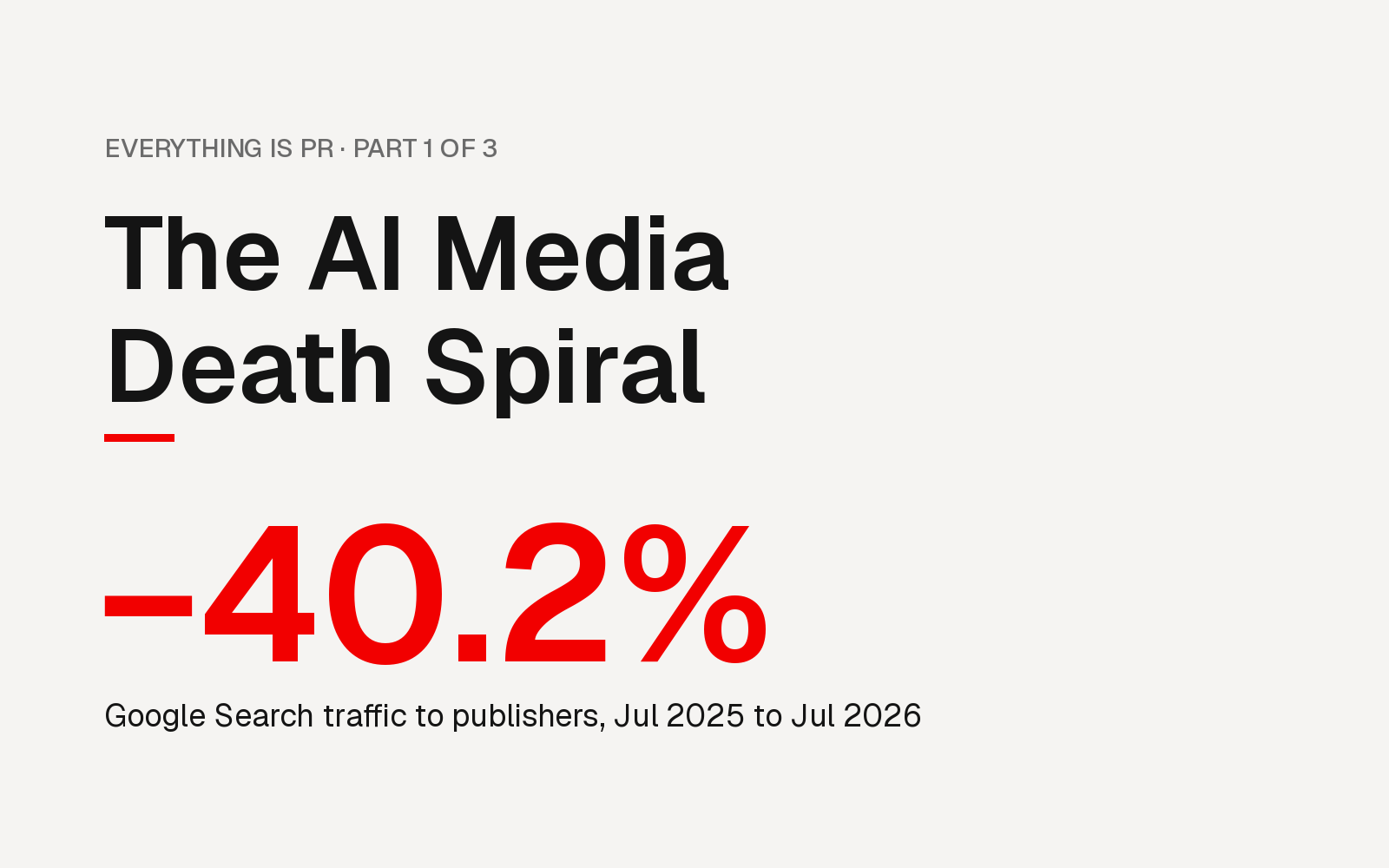
Between July 2025 and July 2026, Google Search traffic to publishers fell 40.2%, according to Chartbeat's data across its publisher network. The year before, it fell 21.9%.
When Google shows an AI summary, people click through to a result 8% of the time, against 15% when it doesn't. Only 1% click a source link inside the summary. AI chatbots send publishers less than 1% of their traffic.
The answer now sits on the results page. The click that used to pay for the reporting happens less and less.
2. The newsrooms shrank
On 4 February 2026, the Washington Post cut more than 300 of its roughly 800 journalists in one day, more than a third of the newsroom. Its executive editor's memo noted that organic search traffic had fallen by nearly half in three years.
US news-industry job cuts reached 1,901 in the first nine months of 2026, up 9% on the same months last year, according to Challenger, Gray & Christmas. Channel 4 cut 28% of its workforce. Business Insider cut 21% of its staff and said "70% of our business has some degree of traffic sensitivity."
Read how the cuts were announced. USA Today Co: "Search traffic is under pressure." Future, which publishes TechRadar and Tom's Guide: an "ongoing decline in search traffic." Scripps: "We're leaning into AI, automation, technology and the centralisation of some roles." Same pressure, two kinds of press release. One is a confession. The other is a pivot.
3. Speed won, checking lost
Not every outlet, but enough of them. Long before AI, a large share of news was other news, repeated. The same Pew study found that eight out of ten stories "simply repeated or repackaged previously published information." In France, researchers found only 32.6% of online news content was original, and a quarter of news stories were reproduced elsewhere online in less than four minutes. Add a quote, rewrite the headline, publish first.
The people whose job was to slow that down went first. US dailies employed 10,676 copy editors in 2002 and 5,675 in 2012. Full-time statehouse reporters at US newspapers fell from 374 to 245 between 2014 and 2022. In 2025, more than 30 fact-checking projects closed worldwide, against 10 that launched.
Studies of US dailies by the journalism scholar Scott Maier found at least one error in 61% of local stories, and fewer than 2% of factually flawed articles corrected. Not every study agrees that speed is the cause: one in Croatia found it barely changed error rates. But the capacity to check has been cut for two decades.
4. AI citation made it worse
Now the reader who no longer clicks asks an AI. In a Tow Center test at Columbia, eight AI search tools were given excerpts from real news articles and asked to name the source. They got it wrong in more than 60% of cases. Perplexity was wrong 37% of the time; Grok 3, 94%. They often cited syndicated copies instead of the original outlet, and 154 of 200 links from Grok 3 led to error pages.
A study led by the BBC with 22 public broadcasters in 18 countries checked more than 3,000 AI answers about the news. Close to half had at least one significant issue.
The machines also stopped saying "I don't know." NewsGuard's annual audit of ten leading chatbots found they repeated a provably false news claim 18% of the time in August 2024, and 35% in August 2025, while the share of questions they declined to answer fell to zero. Meanwhile NewsGuard has identified 3,749 AI content-farm "news" sites, up from 49 when it started counting in May 2023.
The errors reach the best newsrooms too. In May, the New York Times published an editors' note: a quote it had printed from Canadian politician Pierre Poilievre was "an A.I.-generated summary of his views." The note was direct: "The reporter should have checked the accuracy of what the A.I. tool returned."
5. Trust fell, and the loop closed
Trust in news is 37% across 48 markets, the lowest the Reuters Institute has recorded since it started measuring in 2015. The share of people worried about what is real or fake online rose from 58% to 62% in a year.
Fewer clicks, less money. Less money, fewer people checking. The answer arrives through an AI that often gets the source wrong. Trust falls again. Step five feeds step one.
What the spiral doesn't kill
Here is the strongest argument against everything above. Google traffic fell 40%, but total pageviews across Chartbeat's network barely moved, from about 32 billion a month to 31.1 billion. Chartbeat itself calls it a redistribution, not a collapse. In the US, Gallup's measure of trust in the media actually rose this year, from a record low of 28% to 33%.
Readers did not vanish. They moved: to social, to apps, to newsletters like this one, to outlets they go to directly. The spiral does not eat journalism. It eats the middle: the generic, the search-dependent, the copied.
The check before you pitch, buy or cite
If you work in communications, the outlet list you used two years ago is not the outlet list you have now. Four questions before a placement:
- Does the outlet still have a named editor on the beat?
- When it got something wrong in the last year, did it correct it, and how fast?
- Where do its readers come from: search, social, or direct?
- Is the byline a person you can find?
All the numbers behind this piece, with charts and sources: The AI Media Death Spiral: the numbers.
Next, Part 2: the feeds fill. When newsrooms empty and trust sits at 37%, people want receipts. The receipt is a screenshot, and screenshots are now faked and fed to chatbots to "confirm" them.
Checked as of 8 October 2026. Spotted an error? Reply and I'll correct it here, dated.